Wednesday, September 30, 2015

Pawn Sacrifice

The Bobby Fischer/Boris Spassky world chess championship in the summer of 1972 was one of the most followed sports dramas of the Cold War era.   The film Pawn Sacrifice by director Edward Zwick (Glory, The Last Samurai) recounts this epic battle that pitted the best of the Soviet system against an enigmatic and mercurial young prodigy from Brooklyn.  Taking on the enormously difficult task of dramatizing the best of 24 game series and profiling the tempestuous and eccentric Fischer, Zwick largely succeeds in making a film that is at one time a Cold War drama, a character study and a time piece.  Tobey Maguire clearly spent a great deal of time studying Fischer, and nailed his mannerisms, gait, and irascibility and Liev Schreiber portrays the confident, more dashing Boris Spassky with real panache.

Bobby Fischer was one of the most interesting figures in American popular culture of the 1970’s.  Raised by a single mom (who was under investigation by the F.B.I. for her subversive activities), Fischer turned to chess at an early age (likely in part as a distraction from his broken home) and learned to play on his own and through hanging around his local chess club in Brooklyn.
Chess in the Soviet Union is its national pastime and Boris Spassky was a product of the Soviet chess system, which identified, culled and trained chess players, and consequently, the Russians dominated the chess world for decades.  The matchup was a classic battle between an American maverick and a representative of the collectivist system.  The Soviets played chess as a team sport and Fischer accused the Soviets of colluding at tournaments.

Fischer’s obsession with the game propelled him to become the youngest grandmaster at age 15 and the youngest U.S. Chess Champion at age 20, propelling him into the national media spotlight in the late 60’s and early 70’s.  Seemingly overnight, the socially awkward Fischer became a national sensation.  His stardom spawned a boom in chess, as chess clubs flourished across the country and chess sets flew off the shelves.

The East and West could not fight a hot war without destroying themselves, so they fought proxy wars in other countries, competed for dominance in space, and in 1972, their representatives battled in Reykjavik on a chess board.  Pawn Sacrifice captures this high drama and the vaulting of an unlikely temperamental nerd from Brooklyn to media star.  After losing the initial game, and forfeiting the second because of one of his recurring tantrums over playing conditions, Fischer went on to beat Spassky.  While there was no blood, bullets or guns on the screen, Zwick makes this confrontation every bit as riveting as his other war films- The Last Samurai and Glory.  Interestingly, a couple of months later, Team Canada beat the Soviet Team in the other source of Soviet pride –hockey--in a come from behind effort in their Summit Series. I can’t help but wonder if those two events were a foreshadowing of the collapse of the Soviet Union.

Pawn Sacrifice ends as abruptly as Fischer’s stardom and spends only a few moments on the end game—Fischer’s disappearance from competitive chess and the entire national spotlight (and re-emergence in 1992 to take on Spassky in a rematch), his vagabond existence and his deteriorating mental health.   If you are interested in filling in the missing parts, read “Bobby Fischer Goes to War: How the Soviets Lost the Most Extraordinary Chess Match of All Time,” by David Edmonds and John Eidinow.

The puzzling, contradictory figure of Fischer is perhaps best captured by my two favorite quotes by Fischer.  His steely, cold competitiveness was revealed by Dick Cavett (Cavett himself suffered from bipolar disorder) when Cavett what gave him the most pleasure in chess, Fischer responded, “The moment when I break my opponent’s ego.”  Yet this same solitary and reclusive Bobby Fischer’s last words on his deathbed were, “Nothing is as healing as the human touch.” 

Fischer belongs in that pantheon of genius talents such as John Nash, Vincent van Gough, and Jack Kerouac that were simultaneously given a remarkable gift and a curse to a high degree and Pawn Sacrifice excellently portrays Fischer as a troubled front line soldier in the Cold War that defeated the Soviets on a bloodless battlefield.


Tuesday, September 15, 2015

Summer of Disappointment

As summer winds down and transitions into autumn, I was thinking of an adequate summary of the summer of 2015, as each summer has its own hallmarks and events that make it special and memorable.

But candidly, there is no other way to appropriately label the summer of 2015 other than as the Summer of Disappointment.

Early, in the summer, I joined a group of old friends at Ravinia Park, the local summer outdoor music venue to see The Doobie Brothers (who was at the height of their popularity during my teen and preteen years), to enjoy friendship, a little wine, music and nostalgia.  The weather was more suitable to a November football game at Soldier Field, as we were huddled under jackets and blankets.   The band was late at an already late start time,  and they sounded old, tired, and flat, sounding more like a bad local band playing China Grove at a wedding than the actual Doobie Brothers.  I left after about four songs.  That set the tone for the summer.

Baseball also disappointed.  My beloved White Sox were a flop.  Several off season acquisitions were made to complement starts Chris Sale and Jose Abreau and most baseball writers had predicted this team to contend for a division title.  I was looking forward to several nice summer nights at the ballpark with my son, cheering the team on during the 10th anniversary year of their World Series victory.  The team came out of the gate losing four straight and never really gained any traction.  Adam LaRoche decided to challenge quarterback Jay Cutler for the title of "Biggest Waste of Money in Chicago Sports History." A team that should be in the playoffs is now practically giving away tickets through its app just so there is not a resounding echo in the ballpark every time a player gets a hit.

The other big sports disappointment was, of course, Patrick Kane.  He seemed like he had matured and there were no reported incidents of his drunken frat-boy-like behavior over the last few years until this summer when Kane got himself tangled in a whopper of a problem, being accused of rape at his Buffalo home by a woman that he picked up in a bar.  No charges have been filed yet, and these cases are very difficult.  At worst, he is a violent criminal and may go to jail.  At best, he showed terrible judgment, a penchant for recidivism, and he put himself, his team, and the sport in a terrible position.   It may very well be that Kane has played his last game for the Hawks.

In politics, despite a horde of candidates that threw their hats in the ring, I was certain that Scott Walker would quickly emerge as a front runner.  Nonpoliticians like Donald Trump typically make noise but inevitably sink as things get more serious.  Walker was conservative, tough, survived difficult campaigns and a recall and took on and defeated a rabid public union that threatened to turn Wisconsin into a mobocracy.   He restored fiscal sanity to his state and stood in stark contrast to Illinois, which can't even pay its lottery winners and is bleeding jobs and population.  But as the summer wore on, Trump's brash style continued to dominate the press.  Walker's adjustments made him look more like the Republican establishment of Boehner and McConnell and his support in Iowa plummeted to 3%.  Most ridiculous was his assertion that building a wall at the Canadian border was a legitimate issue.  Of all the serious issues facing the U.S., keeping those crazy Canucks out is not an issue that keeps most Americans awake at night.

In the literary world, the long-awaited, much ballyhooed sequel to To Kill A Mockingbird was set for release this summer.  TKAM is on the list of many readers' top ten most beloved novels.  The reclusive Harper Lee refrained from any other publications for decades, and there was much mystery surrounding her and the true authorship of TKAM remained subject of some speculation, given her relationship with Truman Capote.  Social media was abuzz all summer prior to the release.  At release, it was the fastest selling book in HarperCollins history as fans of TKAM gobbled it up.  But as readers dug in, the reviews came back with such descriptions as, "money grab," and "fraud" as some booksellers offered no-questions-asked refunds and others labelled it an "academic curiosity."  Go Set A Watchman landed with the biggest thud in literary history.

Even nature disappointed this summer.  The Chicago Botanic Garden splashed news about the blooming of the famous corpse plant (famous to botanists, anyway).   Spike, the corpse plant evidently infrequently blooms and when it does, it emits a strong and foul smell designed to attract insects.  The CBG attracted 57,000 visitors for the event, had news updates, planned to keep the garden open until 2 a.m. and had a live cam set up for people to watch over the internet.  But Spike never bloomed and horticulturalists deemed it to be "past its prime."   Despite Spike's failure to perform, there were no calls for research into a botanic Viagra.

Lest you think I only indict others in this list, I am not exempt.  Summer whizzed by without accomplishing many of the things that were on my list on Memorial Day.  The Wright Brothers by David McCullough and Misbehaving by Richard Thaler still rest upright on my shelf, unread.  The long list of cultural events and institutions that I wished to see only have two checkmarks next to them.   And although I made a mad dash at the end, I barely dented the catalog of house projects that needed to be done--the basement is still full of useless junk.  Oh, and a few pounds of the 15 that I vowed to make disappear are still here, ready for the holiday add-ons.


Tuesday, September 1, 2015

Life is Short--Beware

A friend of mine called me the other day with the assertion that the Ashley Madison (AM) hack and the disclosure that 37 million people were on the hunt for extramarital relationships was yet further evidence of the decay in our moral structure and decline of our civilization.  He is convinced that we have descended into a modern Sodom and Gomorrah and, as a result, the end is just around the corner.  This rampant frolicking was so widespread, he believes, that either the 2nd coming is imminent or that a large proportion of Western Civilization and some parts of the non-Western world will surely be turned into pillars of salt.

My response? Nah.  The AM hack and disclosure evidences nothing really new, and my view is being borne out by the data.  Certainly, the website and technology purporting to facilitate tawdry meetings caused a stir, but not much actually seems to have happened.  Here is why I am not particularly surprised or shocked by any of this.
  • Infidelity is not new.  It has been around a long time.  While good data is hard to come by (yes, people are untruthful about it), there is not much evidence that unsavory behavior is increasing.  In fact, if infidelity did not exist, the entire country music industry would crumble (My personal favorite: "My Wife Ran Off With My Best Friend, and I Sure Do Miss Him").
  • The disproportionate incidence of men engaging in this is also not new. Men, by nature, are more prone to wandering than women (or at least they are much less surreptitious about it).  Cher cleverly once observed, "Husbands are like fires--they go out when they're left unattended." The preliminary data summary I read showed that 83% of the 37 million registered on AM were men and of the women registered, between 2,000 and 12,000 actually read emails.   In fact, the hackers themselves complained about the number of fake female profiles (as a side note, it's always amusing to see criminals whine about someone else's fraudulent behavior).  But given those tiny numbers of women that answered emails, one can logically infer that the numbers of actual meetings and physical encounters were infinitesimally small.  
  • Men being stupid about sex and having out-of-the-mainstream sexual predilections and affairs is certainly not new.  You don't need to look any farther than Bill Clinton, Anthony Weiner (you can't make up a more perfect match between his name and his habits), Gen. David Petraeus and Dennis Hastert in more recent times to Alexander Hamilton in days of yore (who had an affair with a married woman), to know that prurient behavior outside marriage was not invented with the dawn of the internet.
Sexuality is at the core of our human existence yet good data and serious scholarship on human sexuality are relatively rare, mostly because most people are remarkably secretive about this fundamental aspect of their lives.   Edward O. Laumann at the University of Chicago has done some good work (Sex, Love, and Health in America and The Social Organization of Sexuality) and his work is the most comprehensive since McKinsey.  Daniel Berger wrote an interesting book, What Do Women Want? a few years ago that contains some interesting findings on women's sexuality. And for some scientific insight of sexuality on the neurological level, David Linden published a fascinating book, The Compass of Pleasure.  But there is little of substance outside these works that tell us of our habits and norms.   We keep most of the details of this part of our lives out of the sunlight.  

The AM hack spilled some of these details out.  The hackers disseminated lurid thoughts and preferences and identified individuals attached to them in a format that is accessible to the public.  W. Somerset Maugham once somewhat famously observed, "My own belief is that there is hardly anyone whose sexual life, if it were broadcast, would not fill the world at large with surprise and horror."   Similarly, the themes of Nobel Prize winning novelist Mario Vargas Llosa's novels often dealt with a person's "public self," "private self, and "secret self."  The AM hack simply exposed what some great writers have known all along.

None of this is to signal my approbation of AM as a business model or to condone the behavior of those that registered, but I believe that the potential consequences will be largely overblown.  The AM hacking reveals nothing new about human nature.  It should shock no one that many, many people have messy, complicated, and often unfulfilled lives and often behave badly. But the AM hack, along with those of the Office of Personnel Management, Defense Department and other commercial hacks show us how vulnerable and lasting information is once it is put in electronic form. Addressing security in this part of our new infrastructure is an initiative in which this current administration has shown little interest.  Our government, power grid, and financial infrastructure remain highly vulnerable to hackers.

Yes, the hack has caused a lot of red faces and anxiety among those who were registered on AM, and smug jokes from people who weren't.  Ironically, the AM data dump occurred on the same week that the FDA approved a drug to enhance women's libido.  So at a time when women have the potential to have their interest elevated, many will be supremely furious at their husbands.

In the end,  my prediction is that the fallout is likely to be fairly small and contained to a handful of incidents.  I hope there will even be some positive outgrowths from this.  People will be much more careful about their online interactions (including financial ones) and hopefully it will spur institutions and businesses to radically beef up their cyber security. The AM situation does not portend the end of Western Civilization.  It is not likely to bring fire and brimstone down upon us.  It merely highlighted two immutable constants of the human condition: human frailty and an overly optimistic confidence in technology.

We should have learned those lessons from the sinking of the Titanic.


Monday, August 24, 2015

In The Game - the more things change...


I had an opportunity to attend the premier of In the Game, a film produced by the same company that produced Hoop Dreams.  This film held special significance for me, however.  It focused on the girls' soccer team at Kelly High School, a  Chicago public high school I attended nearly 40 years ago.  At the premier, I was also able to meet and speak with the producer, the principal of the school, and the coach and players that were featured in the film.  A large part of the experience was a nostalgia trip. While the ethnicity, sport, and gender were different, the struggles of trying to be an student athlete, in an underfunded school with few resources in blue collar, immigrant neighborhood resonated with me.  The film centered on these beautiful, spirited young women, trying to make something of themselves, using soccer to build the life skills needed to succeed in life and transcend this tough, poor, gritty (and now gang infested) neighborhood.  The movie struck a chord of both empathy for the girls and a deep sense of nostalgia.

The film did a great job of depicting the Brighton Park neighborhood and highlighted it as an immigrant gateway, showing the transition from a primarily Polish and Lithuanian enclave to a Mexican one.  The houses and parks still looked very familiar to me decades later, although most of the stores have changed and the red, green and white colors of the Mexican flag adorn many of them and many houses have symbols of Catholicism both inside and outside their homes.  The neighborhood is appreciably poorer (the head of the Brighton Park neighborhood council asserted an 86% poverty rate).  Many of the manufacturing companies that supported families in the 50's, 60's and 70's have moved out.  It appears that many people support themselves with little micro businesses and retail shops.  Of course, the other significant change since I grew up is the infiltration of gangs and gang violence.  Just last week, there was a gang related killing at 47th and Western, just a few blocks from my home.  And the film noted that the soccer team was forced to change practice fields because of the threat of gang violence.

Still, I couldn't help feeling a connection with these athletes.  One girl noted, "When I am on the field, everything else disappears."  It was inspiring to see these girls battle through family difficulties, poverty, and lack of infrastructure and resources to work hard and play hard every day.   In the suburbs, similar girls start with travel soccer, have personal trainers, and sometimes tutors.   These girls have to do it largely on their own grit and determination and a very devoted and dedicated coach.   Most of the girls at Kelly do not have money to go to college and have to rely on aid, loans and part time jobs.  It's very difficult for any to go straight through to a 4 year college.  It appears most start and stop through community college.   You can't help but cheer for these girls, any one of which you would be proud to have as your daughter.  The coach, a Kelly graduate of Polish heritage is a both a beacon of hope for these girls and a bridge between generations and waves of immigrants. His unyielding optimism and can-do spirit clearly infects his players.

Of course, as Orwell put it, "all art is propaganda," and this film has a political message to it, both in terms of immigration policy and school funding.  Some of the girls are undocumented and Kelly was subject to pretty draconian budget cuts.  Ironically, the very next day, the Chicago Tribune ran a long piece on the financial condition of the Chicago Public School system and the gross financial mismanagement of it and its pension system.

These girls deserve so much more.  It is heartbreaking to see them caught in a system that was largely constructed and run for the benefit of the unions and politicians and not for the kids.  But simply giving more money to a broken system will not solve the problem.  Twenty percent of funding now goes to pay pension costs and service debt.  That leaves precious little for aspiring student athletes like these girls.

The film underscored for me that the system needs radical reform, not just meddling at the edges and taking holidays from payment into the pension system.  The system needs to go into bankruptcy, with material adjustments to the union contract (so bad teachers can be fired more easily), the pension system, "sweetheart" contracts, and the like and the system needs to be rebuilt under court supervision.  That is the only way I see these kids getting a fair shake.

The filmmakers did a good job of evoking an emotional reaction--it is what good films do.  But the solution that has a chance at fixing the problem may be different than the one they intended.


Monday, August 10, 2015

Best of Enemies

I was seriously misled by the title of this movie. 
There are several progressive friends of mine with whom I engage in verbal and email debates, and while these engagements can be quite spirited and heated and occasionally devolve into mostly good natured potshots at each others’ arguments and selective treatment of factual information to support arguments, we remain friends.  This is kind of relationship between William F. Buckley and Gore Vidal that the title of the film about the debates between them during the 1968 conventions suggested.

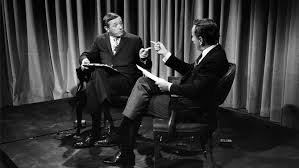
It couldn’t have been farther from the truth.  I expected to see a film about two antagonists that ultimately respected each others’ intellect and liked each other personally.  While the former may have been true to some extent, Buckley and Vidal really did despise each other.  The true enmity between them dripped throughout the film.  Each man saw each other as dangerous and the embodiment of evil, and the antipathy that reached a crescendo  with Buckley threatening Vidal with physical assault on air, calling him a “queer” for calling Buckley a “crypto-Nazi.”  Later, Buckley sued Vidal for publishing an article that challenged Buckley’s sexuality.  This battle between titanic intellects got mean and personal.

The film contained three themes that made it a must see for those interested in public discourse:  the stark contrast and deep antagonism between these two men that has carried over into our divided politics today, the debates were a timepiece of history and media (there were only 3 major networks), the explosive Democratic National Convention was going on, and the Vietnam War and perceived breakdown of law, order and social mores was occurring.  But the last, and in my mind, not least important,  theme enveloped me in sadness—to see these two powerful intellects wane in terms of influence and sink into old age and death.  In particular, I was taken by Buckley’s statement near the end of his life that, if given an opportunity to take a magic pill that would make him 25 years younger, he would decline, and that he was “tired of living.”  Likewise, you could feel the pain that Vidal felt toward the end when he realized that “no one reads his books anymore,”  after toiling for a lifetime and pouring his soul into them. 

This film was significant for me.  Bill Buckley had a strong influence on my thinking when I was a young man and inspired my intellect.   Best of Enemies gave me an opportunity to see a side of him that I had not seen before.   While I had lionized Buckley, the movie showed a human side of WFB that I had not seen before and  suggests strongly  that Vidal ultimately prevailed in this contest, primarily because Vidal had gotten under Buckley’s skin so badly that the usually controlled and affable Buckley threatened him.  Buckley himself  recognized  that this incident was not a shining moment in his career. 

But I have a different view.  While Vidal certainly left behind a larger body of written work, Buckley’s intellectual and political influence was much wider.  He was certainly a factor in the election of the most significant political figure in my lifetime-Ronald Reagan, a president even Barack Obama tries to compare himself to.  Reagan’s conservative core has spawned a new generation of politicians that carry his banner—Scott Walker, Marco Rubio, Ted Cruz and Mike Pence, all hoping to emulate him.  Vidal did not carry that much influence.

Unfortunately, conservatives have not yet found a person that is capable of serving as the intellectual standard bearer.  Laura Ingraham and Mark Levin have some following.  Neither has the intellectual depth.  Perhaps the nearest to Buckley’s intellectual level is Charles Krauthammer, but Krauthammer does not have Buckley’s charm or wonderfully biting sense of humor.


Perhaps there will never be another.

Friday, July 24, 2015

The Eastland and Government Regulation

Today marks the 100th anniversary of the capsizing of the S.S. Eastland in the Chicago River, trapping and drowning 844 passengers, most of whom were Western Electric employees on a family picnic.  Of the 844, most were women and children and over 250 were teenagers or young children.  This disaster has a place along with the Chicago Fire and the Iroquois Theater fire as the deadliest and most scarring in Chicago history.  The photos found on the internet of bodies being recovered still haunt today, and recently actual film footage was recently discovered in Europe (www.eastlanddisaster.org).

For years, many theories and myths surrounded the causes of the disaster.  A common tale passed down was that the passengers all moved to one side of the boat to witness a commotion on land.  That theory turned out to be a myth.  In 2005, George Hinton published a well researched book, Eastland: Legacy of the Titanic.  Hinton documented the construction and history of the ship and consulted with maritime engineers.   The Eastland had a history of stability issues from the start.  But the government regulation that required a place in a lifeboat for every passenger turned out to be a major contributor to this catastrophe [although that conclusion has been disputed by Michael McCarthy in his recent book : Ashes Under Water: The SS Eastland and the Shipwreck that Shook America].  The Eastland was not designed to carry the lifeboats and could not handle the additional bulk and weight.   As a result, in a matter of minutes, on that fateful July day, hundreds of lives were cruelly snuffed out.

We should never forget that tragedy.  But we should also never forget the real consequences when government regulation is blindly applied.  As Nassim Taleb so wisely noted in his book Antifragile, government often inadvertently and tragically increases risks when trying to control them.

Thursday, July 16, 2015

If You Like Your Centrifuges, You Can Keep Your Centrifuges... Really

There are lots of happy faces in Tehran this week.   Not since the U.S.S.R. invaded Afghanistan and deployed intermediate range missiles in Eastern Europe have I so feared for the survival of the West.   Fortunately, we had Reagan and Thatcher (and Helmut Kohl) to pull our chestnuts out of the fire that time.   Despite the howling of the nuclear freeze crowd and the overt mocking of Ronald Reagan as the "amiable dunce" and the "simpleton warmonger,"  Reagan knew when to compromise and when to walk from a deal, as he wisely did in Reykjavik when he refused to commit not to deploy the strategic defense initiative (derided by Ted Kennedy and others as "Star Wars."

Well, the nuclear freeze, medal tossing folks are in charge of our national security now and it shows.  Less than 90 days after the Chinese launch a major cyberattack on a pitifully exposed OPM database protected by a washed up school administrator, the Iranians, starting from a position of complete weakness, and on their knees economically, ran the table on Team Obama.   Others have written more fulsome analyses of this catastrophic "deal" so I will just highlight the few points that I find most repugnant.


  • $140 billion signing bonus.  Money is fungible.  Tehran has extended a line of credit to Bashar al-Assad.   Therefore, the United States is a large financier of terrorism in the Middle East.  For the sake of full transparency, I propose that all Hamas missiles now bear, "Financed by U.S.A. and E.U." labels on them.
  • We left 4 Americans hostage in Iran that were not part of the deal.  Perhaps we should be thankful that the mullahs did not demand more.  But we released 5 Gitmo jihadis for deserter Bergdahl because of our commitment to "do everything we can to bring him home."  To facilitate this "deal," however, the 4 Americans can rot.  
  • The U.S. has committed to cooperate with Iran to thwart Israeli sabotage to their nuclear program.  Evidently, Stuxnet really pissed off the mullahs.  So, now we have to turn our friends, the Israelis in to the authorities if they try that again.  The mullahs now want us to take on the role of Capos, which we have agreed to do.
  • After the Chairman of the Joint Chiefs of Staff Martin Dempsey exclaimed, "Under no circumstances should we relieve pressure on Iran relative to ballistic missile capabilities and arms trafficking," we promptly agree to the military embargo in 5 years and ballistic missile technology in 8.  So, Obama is willing to sunset restrictions on a terror state and give an explicit timetable for that expiration.  For the Canadians that want to build an oil pipeline in the U.S., however, Obama grants no such timetable for relief.
Of course, Team Obama framed this up as a take this deal or war choice, which was a false choice, and always was.  There were plenty of options other than total war that were available to us.   

This "deal" confers legitimacy and power on a tyrannical and authoritarian regime that remains committed to destroying Israel AND the United States.  It all but ensures that Iran will become a nuclear power and sooner rather than later and cements the hold of the regime on that country.  

Eventually, Israel will have to take matter into its own hands.   If we learned one thing from the Third Reich, it's that evil people most often mean what they say.

Neville Chamberlain, you've been one upped.